How to Read an Aluminum Foil Container Spec Sheet
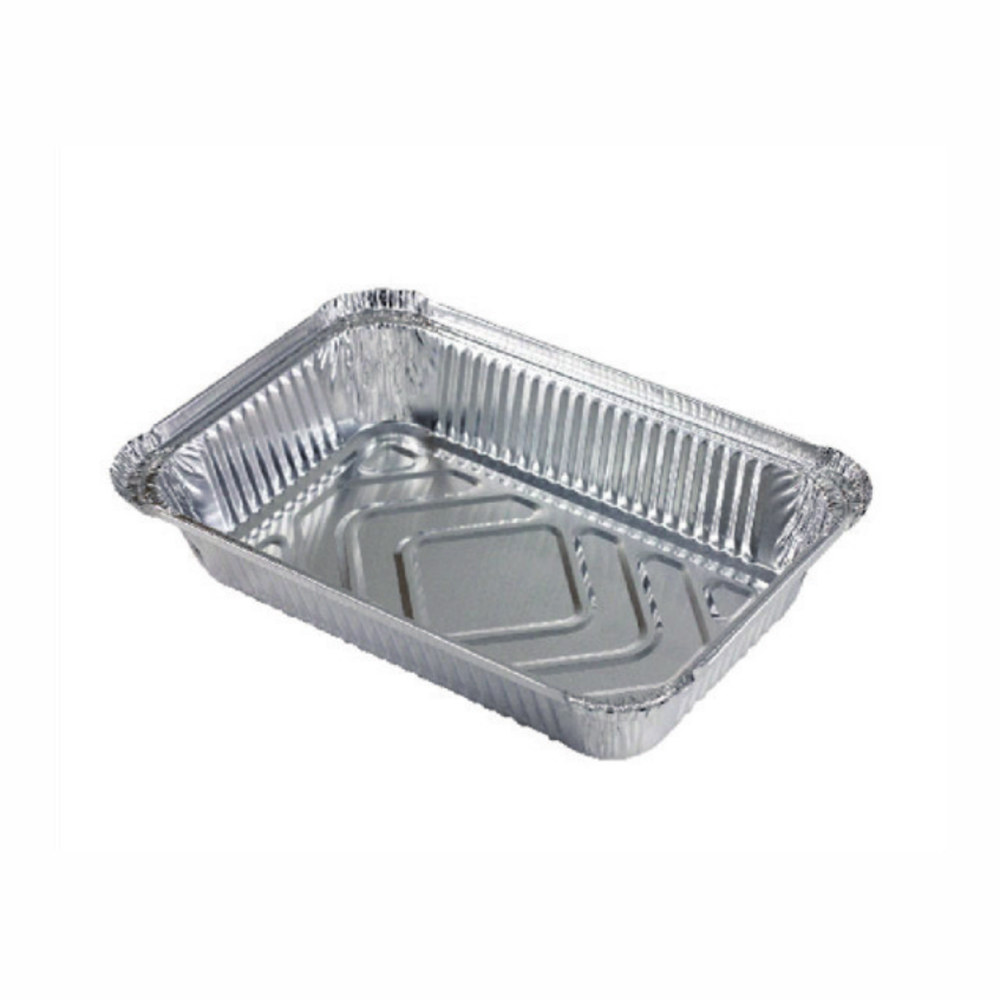
Short answer: A foil container spec sheet is a row of fields, not a single product name. Read six things in order: the size code or factory model; the millimetre dimensions (top-out, and bottom and height if they are given); the capacity in millilitres; the thickness or gauge, plus piece weight if it is listed; the lid type and whether lids are included; and the packing quantity together with the minimum order. A trade code such as 8389 is not an ISO or ASTM standard. AILVBO’s published match is JY-8389: top-out 210×140 mm, bottom 174×103 mm, height 45 mm, about 800 ml, packed 1,000 pieces per carton, with aluminum or plastic lids available and thickness customizable. This website does not publish a micron thickness or a unit weight for that model. The published standard minimum order is 50,000 pieces per item, or 10,000 pieces for a trial order, confirmed on each quotation.
A millimetre (mm) is 10⁻³ m, and a millilitre (ml or mL) is 10⁻³ litre, which is the same volume as 1 cm³. Those conversions come from the SI prefixes and from the litre’s official standing as a special name for the cubic decimetre; they are not factory conventions. “Gauge” is not one worldwide number. In foil trade it often just means thickness, usually written in micrometres (µm, often called microns) or millimetres. If the sheet does not name the unit, ask, or send a sample.
This page walks through those columns with two already published models, JY-8389 and JY-T455. It restates only figures that are already on those product pages, the 2026 catalog, and the order terms on the FAQ and RFQ checklist. It does not invent prices, micron ratings, missing dimensions, or a lid for a model that does not list one.
What each column on a spec sheet means
Most catalogues, factory quotations and PDF tables use the same family of fields, even when the column titles differ. Read the unit on each column before you compare two rows.
| Column you may see | What to read | What is easy to misread |
|---|---|---|
| Model, item, SKU or article | The factory’s own number for that tool, for example JY-8389. | A factory model is not the same thing as a market size code. |
| Size code, size or “8389” | A trade name used in some markets, especially the Gulf, for a familiar rectangular tray. | Codes such as 8389 are not ISO or ASTM standards. Two “8389” rows can differ in height and capacity. |
| Top-out, top out, L × W, or “size” in mm | The widest length and width at the rim, in millimetres. This is the usual lid-fit and stacking width. | A single “size” figure may be only the top-out. It does not replace bottom or height. |
| Bottom, base, or top-in, in mm | The foot of the tray, or the opening inside the rim. Needed if the tray must sit in a sleeve, bag or sealing tool. | Many sheets omit these. A blank cell is not a published dimension. |
| Height, in mm | Base to rim. Height changes fill volume more than buyers often expect. | Two trays can share a top-out and still differ in height. |
| Capacity, volume, ml, mL or cc | How much the tray is claimed to hold. 1 ml = 1 cm³; some sheets write cc for the same unit. | Sheets rarely say whether the figure is brim-full or a working fill. |
| Thickness, gauge, micron, µm or mm | Starting foil thickness, before the tray is formed. | “Gauge” and labels such as “heavy-duty” are not a single worldwide scale. Convert to µm or mm, or match a sample. |
| Weight, grams or g | The finished piece weight of the tray (and, if listed, the lid). | Weight is not the same as thickness. AILVBO publishes a weight on some models and not on others. |
| Lid, cover or “with lid” | Lid type, and whether lids are included or sold separately. | “Lid available” is not the same as “one lid is packed with every tray.” Lids are usually quoted as a separate line. |
| Packing, pcs/ctn or pieces per carton | How many trays are packed in one carton. | Packing is not the minimum order. Carton counts differ by model. |
| MOQ or minimum | The smallest quantity the seller will quote as a production order. | Read whether the minimum is per item or for the whole purchase order. |
AILVBO product pages are written in this same pattern: top-out, bottom and height in millimetres where those figures are published, capacity in millilitres, pieces per carton, and a lid note when one is listed. The RFQ checklist already asks buyers to send those fields the same way.
Worked example: reading two published AILVBO rows
The figures below are copied from the live product pages. Empty cells mean the page does not currently publish that field. They are not estimates.
| Field | JY-8389 | JY-T455 |
|---|---|---|
| What the row is | Rectangular takeout and catering tray; AILVBO’s published model for the Gulf 8389 size | Extra-large oval roasting / turkey tray |
| Factory model | JY-8389 | JY-T455 |
| Market size code | 8389 (trade name, not an ISO or ASTM standard) | None published |
| Top-out | 210×140 mm | 455×360 mm |
| Bottom | 174×103 mm | Not published on the product page |
| Height | 45 mm | 85 mm |
| Capacity | About 800 ml | 6,800 ml |
| Thickness / gauge | Customizable; no micron or millimetre thickness is published | No micron or millimetre thickness is published |
| Piece weight | Not currently published | 73 g |
| Lid | Aluminum or plastic lids available | No lid type is listed on the product page |
| Standard packing | 1,000 pieces per carton | 50 pieces per carton |
| MOQ | The website minimum of 50,000 pieces per item, or 10,000 as a trial order; confirmed on the quotation | Same published site minimum; confirmed on the quotation |
Three reading lessons follow from that table.
First, a size code and a factory model can sit on the same row and still need the millimetre columns. JY-8389 is the published AILVBO model for the 8389 size, at 210×140×45 mm and about 800 ml. Public Gulf 8389 lists often use a 210×140 mm top-out with a different height or capacity. The Gulf size-code chart and the 8389 Gulf market guide explain that disagreement. This page does not repeat those charts.
Second, two complete-looking rows are not filled in the same way. JY-8389 publishes a bottom size and a lid note, but not a piece weight or a micron thickness. JY-T455 publishes a piece weight (73 g) and a much smaller carton count (50 pieces), but not a bottom size and not a lid type. Do not copy a field from one model onto the other.
Third, packing is not MOQ. A carton of JY-8389 is 1,000 pieces; a carton of JY-T455 is 50 pieces. The published order minimum is a separate, site-wide figure: 50,000 pieces per item, or 10,000 pieces for a trial order.
A smaller rectangular tray such as JY-R180 (top-out 185×135 mm, height 50 mm, 700 ml, packed 1,000 pieces, lid available) is not a substitute for JY-8389, even though both are oblong takeout boxes. The top-out is different. Compare the millimetre columns, not the marketing description.
Size codes and factory model numbers
Read the identifier column as two possible things.
A factory model (for example JY-8389 or JY-T455) points to one published tool on this website. Use that number on an RFQ when you have it.
A size code (for example 8389, 8342 or 83120) is a stock-keeping name used by many distributors, especially in the United Arab Emirates and Saudi Arabia. As the Gulf foil container size codes page already states, these codes are not formal ISO or ASTM standards. The last digits often track a claimed volume, but that pattern is a hint, not a guarantee. Public lists already disagree on height and, in some cases, on capacity.
If the sheet gives only a code, add top-out, bottom and height in millimetres, plus capacity in millilitres, before you treat two offers as the same product. AILVBO currently publishes one confirmed 8389-size model, JY-8389. This website does not yet list official AILVBO model numbers for 8342, 8357, 8365, 8368, 83120 or 83185. The current catalog lists 30 standard models across six categories.
Millimetres: top-out, bottom and height
On a spec sheet, “mm” is the millimetre, an SI prefixed unit of length: 1 mm = 10⁻³ m, from the SI prefixes published by the International Bureau of Weights and Measures (BIPM).
For a formed tray, those millimetres are not one number. AILVBO’s sizes guide already defines the usual set:
- Top-out is the widest point at the rim. It is the usual figure for lid fit and stacking width.
- Top-in is the opening inside the rim.
- Bottom (or base) is the footprint of the tray.
- Height is measured from the base to the rim.
A quotation that lists only “210×140 mm” has given you the top-out, or has not said which dimension it is. For JY-8389 the published set is top-out 210×140 mm, bottom 174×103 mm and height 45 mm. For JY-T455 the published set is top-out 455×360 mm and height 85 mm; the product page does not currently list a bottom or a top-in. If a fit is critical — a sleeve, a sealing tool, an oven rack or a lid you already stock — ask for the missing millimetre fields, or request a sample.
How to choose a capacity band for a menu or a restaurant portion is covered in the sizes guide and the restaurant size article. This page does not repeat those use-case tables. If a buyer quotes inches or fluid ounces, convert from the published millimetre and millilitre figures using the foil container size chart in inches and oz.
Millilitres: capacity and fill method
On a spec sheet, “ml” or “mL” is the millilitre. The litre is a special name for the cubic decimetre: 1 L = 1 dm³ = 10⁻³ m³, as stated in the SI Brochure (Table 8) and in Resolution 6 of the 12th CGPM (1964). It follows that 1 ml = 10⁻³ L = 1 cm³ = 10⁻⁶ m³. Some catalogues write cc (cubic centimetre) for the same volume; treat 1 cc as 1 ml unless the sheet defines a different method.
The number on the sheet is a claimed capacity. Two rows with the same top-out can still show different millilitre figures if the height is different, or if one supplier measures brim-full and another measures a working fill. The Gulf size-code page already notes that suppliers rarely state the method.
AILVBO’s sizes guide describes capacity as the liquid volume the container holds when filled to 5 mm below the rim. That is the definition published on this website. It is not an ISO or ASTM test method, and a third-party sheet may use another fill. JY-8389 is published as about 800 ml; JY-T455 is published as 6,800 ml. If the fill method matters to a portion standard, ask for it to be written on the quotation and compare a sample.
Gauge, thickness and piece weight
This is the column that most often mixes units.
| Unit you may see | What it is | Conversion |
|---|---|---|
| Micrometre (µm), often called a micron | SI prefixed unit of length. Common on export foil quotations. | 1 µm = 10⁻⁶ m = 0.001 mm, from the SI prefixes |
| Millimetre (mm) | The same thickness written as a decimal. Common on mill certificates. | 0.050 mm = 50 µm |
| Gauge | In everyday purchasing this usually just means thickness. It is not one worldwide scale. | Do not map a local gauge number to microns automatically. Write µm or mm, or send a sample. |
The Aluminum Association’s Global Advisory Group guidance, Terms and Definitions (GAG 001, 3rd edition, 2011), defines foil as a flat rolled product with uniform thickness equal to or less than 0.20 mm (200 microns). In the United States the stated maximum is 0.0079 inch. The same document defines container foil as single-rolled foil “with a gauge above approximately 35 µm,” in a soft or intermediate temper, often in 3xxx and 8xxx alloys, intended for press forming into smooth or wrinkled food containers. Those clauses are industry term definitions for the starting strip. They are not AILVBO’s published thickness for any container model, and they are not a house light / medium / heavy-duty grade table.
What this website actually publishes:
- For foil containers, AILVBO does not currently publish a micron or millimetre thickness on individual model pages. On JY-8389, thickness is described as customizable. No default micron rating is listed.
- The one published thickness figure on the website and in the 2026 catalog is for the foil roll JY-FR30: 10 micron (which is 0.010 mm), in 30 cm width, as 5 m or 10 m rolls. Width, length and roll gauge are explained in the foil roll buying guide. Do not apply the 10 micron roll figure to a container.
- Some container models publish a piece weight instead of a thickness. JY-T455 is listed at 73 g. Piece weight describes the finished tray. It is useful, but it is not a substitute for a micron figure if your specification is written in µm.
If a sheet says only “standard” or “heavy-duty,” ask for the thickness in microns or millimetres and, if you have it, the finished piece weight. The thickness and gauge guide collects the published piece weights and the one published roll thickness. If you already use a tray you like, the RFQ checklist already suggests asking the factory to match the thickness of a reference sample.
AILVBO publishes that its containers are made from food-grade 3003 and 8011 aluminum alloys. It does not publish a model-by-model alloy list. Do not read an alloy into a blank cell, and do not assume a given model is only 3003 or only 8011. If a specification names one designation, write it on the RFQ and ask the quotation to state the alloy that will be supplied.
Lids
Read the lid column as three separate facts: whether a lid is offered, which type, and whether it is included in the pack count or quoted on its own line.
AILVBO’s published lid options, gathered on the lids guide, are aluminum foil lids, cardboard lids that can be printed with a logo, PET dome lids, and, for JY-8389, plastic lids. Lids are usually quoted as a separate line. This website does not publish a separate lid MOQ, so that quantity is confirmed on the quotation. Say how many lids you need per container.
“Lid available” on a product page, as on JY-8389 and JY-R180, means a lid can be discussed for that model. It does not, by itself, tell you the type, the pack count, or the lid minimum. JY-T455 does not currently list a lid type; if you need a lid for that tray, name the type on the RFQ and ask for the match to be confirmed. This website does not publish a complete lid-to-model matrix.
The containers themselves are published as oven-safe to 260°C (500°F) in a conventional or convection oven, and are not for microwave use. Aluminum lids are described as oven-safe. Cardboard lids and plastic PET or PP dome lids should be removed before baking. Those use rules belong on the lids guide and the oven guide; this page does not repeat them in full.
MOQ and packing
These two columns are often placed next to each other and are not the same number.
Packing is how the goods are counted into cartons. AILVBO’s standard packing is shrink-wrapped in cartons. The carton count is a model field: JY-8389 is published at 1,000 pieces per carton; JY-T455 is published at 50 pieces per carton. Other models differ (for example, the MOQ guide notes that JY-G1100 is published at 500 pieces per carton). Optional packing already listed on the site includes individual PE bags, color boxes, display cartons, palletized shipping and the buyer’s own shipping marks. Carton counts and FOB packing are explained in the packing and shipping guide.
MOQ is the published minimum production quantity. AILVBO’s standard minimum is 50,000 pieces per item. For new customers, a trial order of 10,000 pieces is available. Custom designs may require a higher minimum, depending on mold complexity. These figures are confirmed on each quotation. “Per item” is part of the published wording: it is not automatically “50,000 pieces for the whole purchase order.” The MOQ guide explains how that is counted, how a trial order differs from a free sample, and why the 50,000 / 10,000 figures should not be applied automatically to foil rolls.
Samples of existing products are free; the buyer pays the shipping cost. Sample lead time is 5–7 days. A sample is for checking fit, lid, packing and food use. It is not the 10,000-piece trial order. See How to Get a Sample of Aluminum Foil Containers.
Neighbouring order terms, already published on the FAQ, catalog and RFQ pages, and confirmed on each quotation:
| Term | What AILVBO publishes |
|---|---|
| Standard production | 15–20 days after deposit |
| Custom mold | Typically 15–20 days to develop, then 25–30 days of production after mold approval |
| Trade term | FOB Qingdao or Shanghai |
| Payment | T/T (30% deposit, 70% before shipment) or L/C at sight |
| Material | Food-grade 3003 and 8011 aluminum alloys, for the container range |
Factory windows are explained in the lead time guide. A new shape needs a custom mold. This website does not list prices.
How to use the sheet when you request a quotation
Once you can read the row, send the same fields back, rather than only a code or a photograph. The RFQ checklist is the complete list and includes a copy-and-paste template and a CSV file. A short reading-to-RFQ path is:
- 1. Copy the factory model if you have one (for example JY-8389). If you only have a trade code, add top-out, bottom and height in millimetres and capacity in millilitres.
- 2. Say whether you need lids, which type, and how many per container.
- 3. Give a quantity per model, and say whether you want a 10,000-piece trial or a 50,000-piece standard run.
- 4. If thickness matters, write it in microns or millimetres, add a piece weight if you have one, or ask the factory to match a sample. Do not leave only the word “heavy-duty.”
- 5. State the destination port and the trade term. Published shipments are quoted FOB Qingdao or Shanghai.
- 6. Add packing, printing, sample and ready-date needs in the first message.
You can send that through the contact page, email fliany365@gmail.com, or WhatsApp +86 15810953132. Browse models on the products page or in the product catalog (PDF).
AILVBO has manufactured food-grade aluminum foil containers in Gongyi City, Yong'an Subdistrict, Henan Province, China 451200, since 2007.
Frequently asked questions
What do the columns on a foil container spec sheet mean?
Read the size code or factory model, the millimetre dimensions (top-out, and bottom and height if given), the capacity in millilitres, the thickness or gauge and any piece weight, the lid type, and the packing quantity together with the minimum order. Compare units and missing cells before you treat two rows as the same product.
What does a size code such as 8389 mean?
It is a trade name used by many distributors, especially in the UAE and Saudi Arabia, not an ISO or ASTM standard. AILVBO’s published 8389-size model is JY-8389, at 210×140×45 mm, bottom 174×103 mm, about 800 ml, packed 1,000 pieces per carton. Public listings for the same code can use a different height or capacity. See the Gulf size-code chart.
What is the difference between mm and ml on a spec sheet?
Millimetres (mm) are lengths: top-out, bottom and height. Millilitres (ml) are volume: the claimed capacity of the tray. 1 mm = 10⁻³ m. 1 ml = 1 cm³. Some sheets write cc, which is usually the same volume as 1 ml. A change in height can change the millilitre figure even when the top-out in millimetres stays the same.
What does gauge or thickness mean, and does AILVBO publish a micron figure for containers?
In this trade, gauge usually means the thickness of the starting foil, written in micrometres or millimetres. It is not one worldwide scale. AILVBO does not currently publish a micron thickness for individual container models; on JY-8389, thickness is customizable. The one published thickness figure on this website is for the foil roll JY-FR30: 10 micron. Some containers publish a piece weight instead, for example JY-T455 at 73 g.
Are lids included in the container packing count and the MOQ?
Not automatically. Lids are usually quoted as a separate line. Packing figures such as 1,000 pieces per carton for JY-8389 are for the containers. The published MOQ of 50,000 pieces per item (10,000 for a trial order) is also a container figure. This website does not publish a separate lid MOQ. Say the lid type and how many lids you need per container. Details are on the lids guide and the MOQ guide.
Why do two spec sheets with the same size code show different numbers?
Because the code is a trade name, not a single official drawing. Factories use different heights, and capacity may be brim-full or a working fill. Always compare top-out, bottom, height, capacity, thickness or piece weight, lid and packing, and ask for a sample if you are switching a programme.
Is the published capacity brim-full or a working fill?
Many third-party sheets do not say. AILVBO’s sizes guide describes capacity as the liquid volume held when filled to 5 mm below the rim. That is this website’s published definition, not a formal ISO or ASTM method. JY-8389 is listed as about 800 ml; JY-T455 as 6,800 ml. If the fill method matters, have it written on the quotation.
How should I use a spec sheet when I request a quotation?
Copy the model or the measured millimetre dimensions and millilitre capacity, then add lid type, quantity per model, thickness or a reference sample, destination port and trade term. Use the RFQ checklist, email fliany365@gmail.com, or WhatsApp +86 15810953132. Samples of existing models are free; the buyer pays freight.
Sources
- BIPM, SI prefixes (milli = 10⁻³, micro = 10⁻⁶): https://www.bipm.org/en/measurement-units/si-prefixes
- BIPM, The International System of Units (SI), 9th edition (SI Brochure), Table 8: the litre is a non-SI unit accepted for use with the SI, with 1 L = 1 dm³ = 10⁻³ m³: https://www.bipm.org/en/publications/si-brochure and https://www.bipm.org/documents/20126/41483022/SI-Brochure-9-EN.pdf
- 12th CGPM (1964), Resolution 6, declaring that the word “litre” may be employed as a special name for the cubic decimetre: https://www.bipm.org/en/committees/cg/cgpm/12-1964/resolution-6
- The Aluminum Association, Global Advisory Group, GAG Guidance Document 001, Terms and Definitions, 3rd edition, 2011-01, clauses 2.7.1 (foil ≤ 0.20 mm / 200 microns; US maximum 0.0079 inch) and 2.7.3 (container foil, a gauge above approximately 35 µm): https://www.aluminum.org/sites/default/files/2021-09/GAG_001_Terms_and_Definitions_3rd_Edition_2011_01_August_21_2011_JW.pdf