8389 Aluminum Foil Container: Size, Capacity & Gulf Market Guide
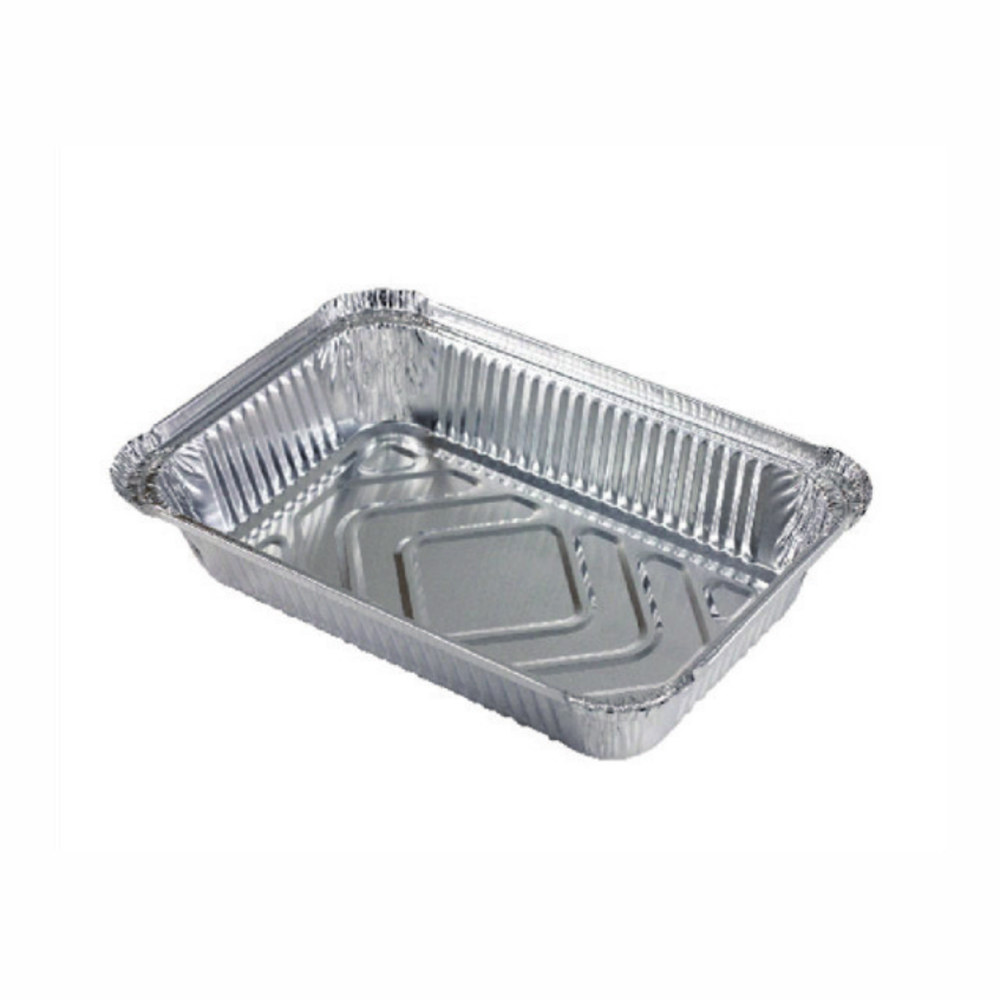
If you buy disposable food packaging in the UAE or Saudi Arabia, “8389” is a size name you will hear often. Restaurant buyers, catering firms, and restaurant-supply distributors use it for a mid-size rectangular aluminum foil tray, usually sold in cartons of 1,000 pieces, often with lids. It is a trade size, not a formal ISO or ASTM standard, and height and claimed capacity vary a little by brand. This guide covers what buyers usually mean by 8389, the dimensions to confirm on a quotation, how the size is used in UAE and Saudi food service, lid and thickness options, and AILVBO’s matching 8389 model, with a smaller catalog alternative if you need less volume.
What Does “8389” Mean?
In the Gulf market, 8389 is a stock size name for a shallow rectangular foil container used for individual meals, takeaway, and catering. You will see it on distributor lists in Dubai, Sharjah, and Saudi Arabia, sometimes as “8389 (HD)” for a heavy-duty version, or as “8389 / 890 cc” when the seller leads with volume.
The name is a market code for a roughly 210 × 140 mm rectangular tray, not a unique patented design. Different factories may also use their own internal model numbers for the same footprint. Because the code is a trade name rather than a published standard, do not order by the number alone: confirm top-out length, width, height, and capacity, and ask whether the lid is included or sold separately.
Typical 8389 Dimensions and Capacity
Gulf suppliers commonly list 210 × 140 × 38 mm, with a capacity of about 800–890 ml, packed 1,000 pieces to a carton. That 210 × 140 mm top-out is the stable part of the spec: lids, carton packing, and stacking all depend on it.
Height and capacity are where listings disagree. Some Gulf lists use a 38 mm height and about 875–890 ml. Other suppliers quote a slightly deeper tray, around 42–45 mm, and a capacity closer to 800 ml. Capacity is not always measured the same way, so treat it as approximate unless the supplier states a fill method. If a quotation says “8389” but the top-out is materially different from 210 × 140 mm, it is a different tray, even if the capacity looks similar.
How 8389 Containers Are Used in UAE and Saudi Kitchens
The 8389 size sits in a useful middle range: large enough for a single main-course portion, small enough to stack densely in a delivery bag or a catering box.
Typical uses include:
- Takeaway and delivery. Rice-and-gravy dishes, grilled chicken, shawarma plates, pasta, and mixed grills travel well in a shallow rectangular tray with a fitted lid. The 210 × 140 mm footprint stacks more efficiently than a round pan of similar volume.
- Hotel and event catering. The size works for plated hot dishes that are packed ahead, held, and then served or delivered. Aluminum conducts heat quickly, so trays can go from a warmer to the table without changing containers.
- Cloud kitchens and meal prep. A consistent single-portion size makes it easier to standardize recipes and carton counts. A 1,000-piece carton is the usual wholesale pack.
It is not right for every menu. Deep stews need a taller wall or a leak-tested lid, and family trays need a larger rectangular or oval pan. Side-dish portions are better in a smaller rectangular container.
Lid Options for 8389 Containers
Lids matter as much as the tray, especially for delivery in hot weather. Sellers do not all include the same lid type, and some quotations list the lid as an option.
- Aluminum lids are oven-safe and can be crimped for a firmer seal, which is useful when the filled tray will be reheated.
- Plastic lids usually snap over the rim and are useful when the customer should see the food. Confirm whether the lid is included in the pack count.
- Board or laminated paper lids are widely used in food service and easy to print for branding. These lids are not a tight liquid seal.
For saucy takeaway, ask whether the lid is a friction-fit board lid, an aluminum lid, or a snap-on plastic lid, and test a sample carton with a wet dish before you roll the size out across outlets.
How to Choose Thickness
Thickness is another variable that changes the “same” 8389 from one supplier to another. Public listings in the Gulf often fall somewhere around 40–63 microns, depending on whether the carton is sold as a light or heavy-duty pack.
Around 40 microns can be acceptable for light, relatively dry portions and short holding times, but the rim and base will flex more under a heavy or wet meal. Around 50–63 microns is a more typical heavy-duty range for this footprint, and it stands up better to stacking, oven reheating, and gravy-heavy dishes. Ask for both the micron rating and the piece weight — two trays can share a 210 × 140 mm top-out and still feel very different in the hand. A thicker tray with a loose board lid will still leak, so specify foil gauge and lid type in the same purchase order, and sample a carton under your real conditions before you commit to a full container load. AILVBO can customize thickness for JY-8389 — contact us for a quotation.
AILVBO’s 8389 Model: JY-8389
AILVBO produces the Gulf 8389 size as JY-8389, a rectangular container in the rectangular aluminum foil container range. The published specifications are a 210 × 140 mm top-out, 45 mm height, and 800 ml capacity, with aluminum or plastic lids available. Thickness is customizable.
| Typical Gulf 8389 listing | AILVBO JY-8389 | AILVBO JY-R180 (smaller alternative) | |
|---|---|---|---|
| Top-out length × width | 210 × 140 mm | 210 × 140 mm | 185 × 135 mm |
| Height | commonly 38 mm | 45 mm | 50 mm |
| Capacity | commonly 800–890 ml | 800 ml | 700 ml |
| Lid | often sold with a lid | Aluminum or plastic lids available | Lid available |
| Packing | typically 1,000 pcs | 1,000 pcs | 1,000 pcs |
JY-8389 matches the standard 210 × 140 mm 8389 footprint. Compared with the 38 mm / 890 ml figures commonly listed by Gulf suppliers, it is 7 mm deeper (45 mm) and its published capacity is 800 ml, at the lower end of the 800–890 ml range. If you already buy 8389 lids or pack to a 210 × 140 mm carton, JY-8389 is the AILVBO model to sample.
If you need a smaller rectangular takeout tray rather than a full 8389, JY-R180 is a useful alternative at 185 × 135 × 50 mm and 700 ml. It is 25 mm shorter and 5 mm narrower than the 8389 footprint, so it is not a drop-in replacement for an existing 8389 program.
AILVBO manufactures in Gongyi, Henan, has operated since 2007, and works with 300+ molds. Request a sample of JY-8389 if you are switching an 8389 program, and confirm lid type and foil thickness on the purchase order. The published path for existing-model samples is in How to Get a Sample of Aluminum Foil Containers?.
What to Specify When You Order
A complete 8389-style quotation, from a Gulf distributor or a factory, should include:
- Top-out length and width, and height, in millimetres.
- Capacity in millilitres, plus how it is measured.
- Foil thickness (microns or millimetres) and piece weight.
- Lid type, and whether lids are included in the pack count.
- Pieces per carton and carton outer size.
- Alloy and food-contact documentation (for example FDA or equivalent test reports).
Those six points will catch most “8389” mismatches before shipment. To send them all in one message, use the RFQ checklist.
Conclusion
8389 is the Gulf market name for a mid-size rectangular aluminum foil container. Gulf suppliers commonly list 210 × 140 × 38 mm and about 800–890 ml. It is widely used for takeaway, catering, and single-portion meals in the UAE and Saudi Arabia, usually sold 1,000 pieces to a carton, with aluminum, plastic, or board lids depending on the supplier. Because height, capacity, and thickness vary by brand, order to a measured specification, not to the code alone.
AILVBO’s 8389 model is JY-8389, at 210 × 140 × 45 mm and 800 ml. For a smaller rectangular takeout tray, see JY-R180 (185 × 135 × 50 mm, 700 ml), or browse other rectangular aluminum foil containers. How those twelve published rectangular models compare is in the rectangular aluminum foil container guide.
For a side-by-side view of other Gulf trade codes used with 8389 — including 8342, 8357, 8365, 8368, 83120 and 83185 — see the Gulf foil container size-code chart. Those codes are market names, not a single standard, so confirm dimensions on the quotation.