Foil Container Size Chart in Inches and Oz
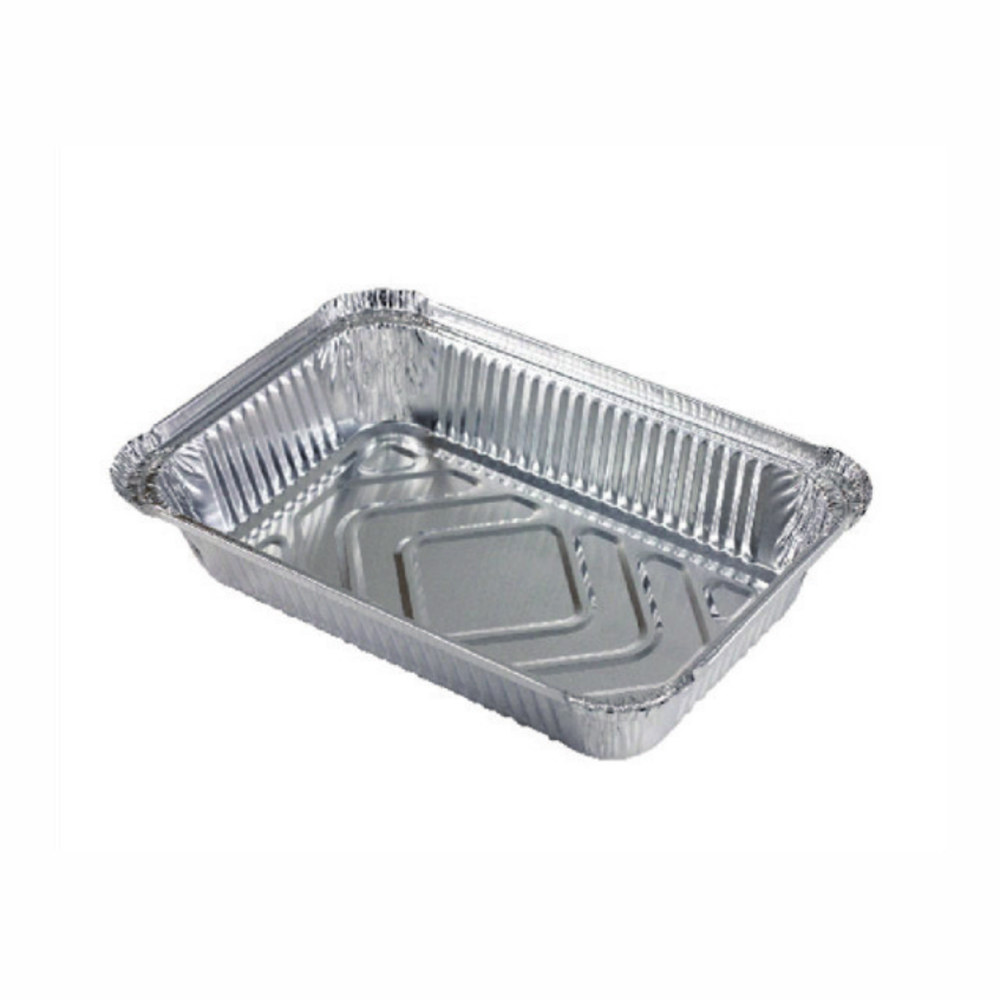
Short answer: To read a foil container size in inches and ounces, start from the published millimetre and millilitre figures and convert them with fixed official factors. Inches = millimetres ÷ 25.4, because the international inch is exactly 25.4 mm. US fluid ounces = millilitres ÷ 29.5735295625, because a US fluid ounce is 1/128 of a US gallon and a US gallon is exactly 231 cubic inches. Imperial (UK) fluid ounces = millilitres ÷ 28.4130625, because an imperial fluid ounce is 1/160 of the UK gallon of 4.54609 litres. On a US foodservice listing, “oz” usually means fluid ounces (volume). The same letters can also mean avoirdupois ounces (weight) when they describe the empty tray. Those two “oz” values are not interchangeable, and a US fluid ounce is not the same size as an imperial fluid ounce.
Two already published AILVBO models, converted with that method and rounded to two decimal places, are:
- JY-8389: top-out 210 × 140 mm, bottom 174 × 103 mm, height 45 mm, about 800 ml → 8.27 × 5.51 in top-out, 6.85 × 4.06 in bottom, 1.77 in height, 27.05 US fl oz (28.16 imperial fl oz). No piece weight is published for this model.
- JY-T455: top-out 455 × 360 mm, height 85 mm, 6,800 ml, unit weight 73 g → 17.91 × 14.17 in top-out, 3.35 in height, 229.94 US fl oz (239.33 imperial fl oz). The 73 g weight converts to 2.57 oz avoirdupois, which is not a volume.
Converted inches and ounces are a reading aid, not a second official drawing. For lid fit, oven-rack fit or a like-for-like replacement, compare the millimetre specification or a sample. This website’s product pages and size guide are written in millimetres and millilitres.
What “inch” and “oz” mean on a foil container sheet
Buyers in the United States, and some buyers in Canada, Mexico and the United Kingdom, still quote trays in inches and in “oz.” Factory catalogues from China, and most European specifications, use millimetres and millilitres. The two systems describe the same tray only after the unit is identified and converted.
| Term you may see | Quantity | Official relationship used on this page | Typical use on a foil container sheet |
|---|---|---|---|
| Inch (in, inch, or ″) | Length | 1 in = 25.4 mm exactly | Top-out, bottom or height, often written as L × W × H |
| Millimetre (mm) | Length | 1 mm = 10⁻³ m | The unit used on AILVBO product pages |
| US fluid ounce (US fl oz, fl oz, oz) | Volume | 1 US fl oz = 29.5735295625 ml exactly, from 1 US gal = 231 in³ and 128 fl oz per gallon | Claimed capacity, especially on US foodservice lists |
| Imperial fluid ounce (imp fl oz, UK fl oz) | Volume | 1 imp fl oz = 28.4130625 ml exactly | Older or UK listings; about 4 % smaller than a US fluid ounce |
| Millilitre (ml or mL) | Volume | 1 ml = 1 cm³ = 10⁻³ L; 1 L = 1 dm³ | The unit used on AILVBO product pages |
| Avoirdupois ounce (oz) | Mass | 1 oz = 28.349523125 g exactly (1/16 of the international pound of 0.45359237 kg) | Empty-tray piece weight, when a weight is published |
| “9-inch” or similar inch name | A trade size name, not automatically a measured inch | Convert the published millimetre figure and compare | Common on round baking pans; see the JY-R9 note below |
| “Lb” turkey-pan rating | A food-weight marketing convention | Not a conversion of millilitres | Do not turn 6,800 ml or 7,200 ml into a turkey weight |
If a sheet says only “oz” and does not say “fl oz” or “g,” check the context. A capacity such as “27 oz” next to a mid-size takeout tray is almost certainly volume. A figure such as “2.57 oz” next to a gram weight is mass. When it is unclear, ask which unit is meant, or convert from the millilitre or gram figure instead of guessing.
Mainland European buyers usually stay in millimetres and millilitres. The conversion still matters when they are matching a US inch / oz request, or checking a UK listing that still uses imperial fluid ounces.
Conversion rules
All conversions on this page use the following exact relationships. The arithmetic is shown so a reader can repeat it.
- 1. Inches from millimetres. Divide by 25.4. This follows the definition of the international inch as exactly 25.4 mm (equivalently, 2.54 cm). The same definition appears in NIST Handbook 44, Appendix C, and is the relationship used for the international yard and foot since 1959 (1 yd = 0.9144 m, 1 ft = 0.3048 m, 1 in = 1/12 ft).
- 2. Cubic inches, if needed. 1 in³ = 25.4³ mm³ = 16.387064 cm³ = 16.387064 ml, exactly.
- 3. US fluid ounces from millilitres. Divide by 29.5735295625. That factor is 231/128 × 16.387064. NIST Handbook 44, Appendix C, defines the US gallon as exactly 231 cubic inches and as exactly 128 US fluid ounces.
- 4. Imperial fluid ounces from millilitres. Divide by 28.4130625. The UK gallon is 4.54609 litres (4.54609 cubic decimetres) in the Weights and Measures Act 1985, and an imperial fluid ounce is 1/160 of that gallon. The Units of Measurement Regulations 1995 state the same imperial fluid ounce as 28.4130625 millilitres.
- 5. Avoirdupois ounces from grams. Divide by 28.349523125. The international pound is 0.45359237 kg exactly; one ounce is 1/16 of that pound. The same gram equivalent is listed in the Units of Measurement Regulations 1995.
- 6. Litres and millilitres. The litre is a non-SI unit accepted for use with the SI, with 1 L = 1 dm³ = 10⁻³ m³, as stated in the BIPM SI Brochure, 9th edition, Table 8. The prefix milli means 10⁻³, so 1 ml = 10⁻³ L = 1 cm³.
Rounding used on this page. Published factory figures are left in millimetres, millilitres and grams exactly as they appear on the product page. Converted inches and ounces are then rounded to two decimal places. Each worked example also shows the unrounded quotient so the arithmetic can be checked. A converted number is not more precise than the published millimetre or millilitre value it came from, and it is not a second official specification.
What this page does not convert. It does not invent a millimetre, millilitre, micron or gram figure that the product page does not publish. It does not say whether a published capacity is brim-full or a working fill; the converted fluid ounces use the published millilitre figure as written. The sizes guide explains how AILVBO describes those measurements. It does not assign alloy 3003 or 8011 to a named model; both alloys are used in AILVBO containers. It does not convert a roasting pan’s millilitre capacity into a “pound of turkey” rating.
Quick conversion reference (units only)
These rows are unit arithmetic, not a catalogue of AILVBO models. Use them to read a millimetre or millilitre figure. For a named model, convert the numbers on that product page.
| Millimetres | Inches (mm ÷ 25.4, 2 d.p.) |
|---|---|
| 25.4 | 1.00 |
| 50 | 1.97 |
| 75 | 2.95 |
| 100 | 3.94 |
| 150 | 5.91 |
| 200 | 7.87 |
| 250 | 9.84 |
| 300 | 11.81 |
| 350 | 13.78 |
| 400 | 15.75 |
| 450 | 17.72 |
| 500 | 19.69 |
| Millilitres | US fl oz (ml ÷ 29.5735295625, 2 d.p.) | Imperial fl oz (ml ÷ 28.4130625, 2 d.p.) |
|---|---|---|
| 100 | 3.38 | 3.52 |
| 250 | 8.45 | 8.80 |
| 500 | 16.91 | 17.60 |
| 750 | 25.36 | 26.40 |
| 800 | 27.05 | 28.16 |
| 1,000 | 33.81 | 35.20 |
| 2,000 | 67.63 | 70.39 |
A useful check: 1,000 ml is about 33.81 US fl oz and about 35.20 imperial fl oz. The imperial fluid ounce is smaller, so the same millilitre capacity produces a slightly larger imperial ounce figure.
To go the other way, multiply inches by 25.4 to obtain millimetres, multiply US fl oz by 29.5735295625 to obtain millilitres, and multiply imperial fl oz by 28.4130625 to obtain millilitres.
Worked example 1: JY-8389
JY-8389 is AILVBO’s published rectangular model for the Gulf 8389 trade size. The product page lists top-out 210 × 140 mm, bottom 174 × 103 mm, height 45 mm, a capacity of about 800 ml, and packing of 1,000 pieces per carton. Aluminum or plastic lids are available. Thickness is customizable; no micron thickness and no unit weight are published. 8389 is a trade name, not an ISO or ASTM standard; the Gulf size-code chart and the 8389 market guide explain that point. The conversions below use only the published millimetre and millilitre figures.
| Published field | Figure on the product page | Calculation | Converted value (2 d.p.) |
|---|---|---|---|
| Top-out length | 210 mm | 210 ÷ 25.4 = 8.2677165354… in | 8.27 in |
| Top-out width | 140 mm | 140 ÷ 25.4 = 5.5118110236… in | 5.51 in |
| Bottom length | 174 mm | 174 ÷ 25.4 = 6.8503937008… in | 6.85 in |
| Bottom width | 103 mm | 103 ÷ 25.4 = 4.0551181102… in | 4.06 in |
| Height | 45 mm | 45 ÷ 25.4 = 1.7716535433… in | 1.77 in |
| Capacity, US | about 800 ml | 800 ÷ 29.5735295625 = 27.0512181615… US fl oz | 27.05 US fl oz |
| Capacity, imperial | about 800 ml | 800 ÷ 28.4130625 = 28.1560637823… imp fl oz | 28.16 imp fl oz |
| Piece weight | Not published | — | Not converted |
In short, a buyer who works in inches can read JY-8389 as about 8.27 × 5.51 × 1.77 in, with a published capacity of about 27.05 US fl oz (28.16 imperial fl oz). If another supplier’s “8389” or “27 oz tray” uses a different height, the fluid-ounce figure will not match; compare the millimetre drawing or a sample rather than the trade name alone.
Worked example 2: JY-T455, with the 470 turkey dish as a converted comparison
JY-T455 is the published extra-large oval roasting tray at top-out 455 × 360 mm, height 85 mm, capacity 6,800 ml, unit weight 73 g, and packing of 50 pieces. The product page does not currently publish a bottom (base) dimension, a lid type, or a micron thickness. Those blanks are not estimated here.
| Published field | Figure on the product page | Calculation | Converted value (2 d.p.) |
|---|---|---|---|
| Top-out length | 455 mm | 455 ÷ 25.4 = 17.9133858268… in | 17.91 in |
| Top-out width | 360 mm | 360 ÷ 25.4 = 14.1732283465… in | 14.17 in |
| Bottom | Not published | — | Not converted |
| Height | 85 mm | 85 ÷ 25.4 = 3.3464566929… in | 3.35 in |
| Capacity, US | 6,800 ml | 6,800 ÷ 29.5735295625 = 229.9353543725… US fl oz | 229.94 US fl oz |
| Capacity, imperial | 6,800 ml | 6,800 ÷ 28.4130625 = 239.3265421494… imp fl oz | 239.33 imp fl oz |
| Piece weight | 73 g | 73 ÷ 28.349523125 = 2.5749992223… oz avdp | 2.57 oz (weight) |
The 229.94 US fl oz capacity and the 2.57 oz piece weight share the letters “oz,” but they measure different quantities. One is volume; the other is the mass of the empty tray.
The live catalogue also includes the 470 turkey dish: top-out 470 × 350 mm, bottom 380 × 265 mm, height 75 mm, capacity 7,200 ml, packed 50 pieces. No unit weight is published. Converted with the same method, that row is 18.50 × 13.78 in top-out (470 ÷ 25.4 = 18.5039370079… in; 350 ÷ 25.4 = 13.7795275591… in), 14.96 × 10.43 in bottom, 2.95 in height, and 243.46 US fl oz (253.40 imperial fl oz). The two trays are not interchangeable: JY-T455 is shorter and wider at the top-out, and taller, with a smaller published capacity. This is a unit comparison of two already published rows, not a recommendation of which roasting pan to buy. Oval models are listed on the oval category page.
Do not convert 6,800 ml or 7,200 ml into an “18 lb turkey pan” or similar food-weight label. That kind of rating describes a suggested bird weight, not a laboratory conversion of millilitres, and AILVBO does not publish such a rating for these models.
Inch trade names are not the same as converted inches
Some product titles on this website use an inch size as a trade name. That name is a familiar family label. It is not automatically the result of dividing the published millimetre figure by 25.4.
JY-R9 is listed as a “9-inch” round baking pan, with a published top-out of Φ232 mm, height 47 mm and capacity 930 ml. 232 ÷ 25.4 = 9.1338582677… in, which rounds to 9.13 in. Exactly 9 in would be 9 × 25.4 = 228.6 mm. The converted top-out is therefore a little over 9 in, even though the trade name is “9-inch.” The published 930 ml converts to 31.45 US fl oz (32.73 imperial fl oz). Use the millimetre figure, not the inch name alone, when you need a lid, a die or a match to an existing pan.
The same caution applies to other US foodservice names. A 9x13 or 8x8 request is a rectangular baking-pan name, not a conversion of a published AILVBO model. Half pan, full pan, steam table and hotel pan are also US foodservice names; they are not listed as size codes on AILVBO product pages. JY-8389’s converted 8.27 × 5.51 in top-out is not 8x8. JY-R9 is a round pan with a “9-inch” trade name (9.13 in from Φ232 mm), not a 9x13 rectangular pan. The 470 turkey dish converts to 18.50 × 13.78 in and is not a 9x13 pan. If you need a starting conversion of the name itself, 8 × 25.4 = 203.2 mm and 13 × 25.4 = 330.2 mm; then compare the published millimetre drawing or a sample, not the name alone.
How to use the conversion when you request a quotation
When you send an inch / oz request to a factory that catalogues in millimetres and millilitres, include both unit systems, or include the conversion you used. A complete enquiry still needs the millimetre top-out, bottom and height if you have them, the millilitre capacity, the lid type, the quantity and the destination port. The RFQ checklist lists those fields. Existing models can be reviewed in the product catalog.
Published order terms, already confirmed and restated on the FAQ, are: standard minimum order 50,000 pieces per item, or 10,000 pieces for a trial order; samples of existing models are free, with freight paid by the buyer; lead time is 15–20 days after the deposit; a new mold takes 15–20 days, then production takes 25–30 days; payment is T/T 30 % deposit and 70 % before shipment, or L/C at sight; prices are quoted FOB Qingdao or Shanghai. Aluminum foil containers may be used in a conventional or convection oven up to 260 °C (500 °F on the FAQ; that Fahrenheit figure is 260 × 9/5 + 32). They are not for microwave use. For oven use, see also Can You Put Aluminum Foil Containers in the Oven?.
To request a sample or a quotation, use the contact page, WhatsApp +86 15810953132, or fliany365@gmail.com.
Frequently asked questions
How do I convert a foil container size from mm and ml to inches and oz?
Divide each millimetre dimension by 25.4 to obtain inches. For capacity, first decide which fluid ounce is required. Divide millilitres by 29.5735295625 for US fluid ounces, or by 28.4130625 for imperial fluid ounces. This page rounds those results to two decimal places and keeps the published millimetre and millilitre figures as the specification. If “oz” on the sheet means the empty-tray weight, divide grams by 28.349523125 instead.
Is “oz” on a foil container listing a fluid ounce or a weight ounce?
It depends on the column. Next to a capacity, “oz” on a US listing usually means US fluid ounces (volume). Next to a gram weight, “oz” means avoirdupois ounces (mass). JY-T455 shows why the distinction matters: 6,800 ml converts to 229.94 US fl oz, while the published 73 g piece weight converts to 2.57 oz avoirdupois. Those numbers are not two ways of writing the same quantity. If the sheet does not say which ounce is meant, ask, or convert from the millilitre or gram figure.
What is the difference between a US fluid ounce and an imperial fluid ounce?
A US fluid ounce is 29.5735295625 ml. An imperial (UK) fluid ounce is 28.4130625 ml, about 4 % smaller. The same 800 ml published for JY-8389 is 27.05 US fl oz or 28.16 imperial fl oz. Do not treat a US “oz” capacity and a UK “oz” capacity as equal without converting both back to millilitres.
What is JY-8389 in inches and ounces?
Using the figures on the JY-8389 product page and the rules above, the converted size is 8.27 × 5.51 in top-out, 6.85 × 4.06 in bottom, 1.77 in height, and 27.05 US fl oz (28.16 imperial fl oz) from the published 800 ml. No piece weight is published, so no weight-ounce figure is given. 8389 remains a Gulf trade name, not an inch standard.
What is JY-T455 in inches and ounces?
Using the figures on the JY-T455 product page, the converted top-out is 17.91 × 14.17 in, the height is 3.35 in, and 6,800 ml is 229.94 US fl oz (239.33 imperial fl oz). The published 73 g unit weight is 2.57 oz avoirdupois. The bottom dimension is not published and is not estimated. The 470 turkey dish converts to a different footprint (18.50 × 13.78 in top-out, 2.95 in height, 243.46 US fl oz from 7,200 ml).
Does a “9-inch” foil pan measure exactly 9 inches?
Not necessarily. An inch trade name is a size family, not a guarantee that the rim is 9.00 in. JY-R9 is titled as a 9-inch round pan and is published at Φ232 mm top-out, which converts to 9.13 in (232 ÷ 25.4). Exactly 9 in is 228.6 mm. Convert the millimetre figure when you need a measured match.
Is JY-8389 an 8x8 pan, or is JY-R9 a 9x13 pan?
No. JY-8389 converts to 8.27 × 5.51 in top-out from the published 210 × 140 mm. An 8x8 name would start from 8 in × 8 in (203.2 × 203.2 mm) and is a different shape. JY-R9 is a round “9-inch” pan at Φ232 mm (9.13 in), not a 9x13 rectangular pan. Half pan, full pan, hotel pan and steam table are not published as AILVBO size codes on this website.
Can I convert 6,800 ml or 7,200 ml into a turkey-weight “lb” size?
No. A “pound” turkey-pan rating is a food-weight convention, not a conversion of millilitres. This page converts the published 6,800 ml and 7,200 ml figures only into fluid ounces and inches. AILVBO does not publish a turkey-weight rating for JY-T455 or the 470 turkey dish.
Are the converted inches a second official specification?
No. The official published dimensions and capacities on this website remain the millimetre and millilitre figures on each product page. Converted inches and ounces are a reading aid, rounded to two decimal places from those figures. For lids, tooling or a replacement programme, use the millimetre drawing or request a sample of an existing model (samples are free; freight is paid by the buyer).
Sources
- BIPM, The International System of Units (SI), 9th edition (SI Brochure), Table 8: the litre is a non-SI unit accepted for use with the SI, with 1 L = 1 dm³ = 10⁻³ m³: https://www.bipm.org/en/publications/si-brochure and https://www.bipm.org/documents/20126/41483022/SI-Brochure-9-EN.pdf
- BIPM, SI prefixes (milli = 10⁻³): https://www.bipm.org/en/measurement-units/si-prefixes
- 12th CGPM (1964), Resolution 6, declaring that the word “litre” may be employed as a special name for the cubic decimetre: https://www.bipm.org/en/committees/cg/cgpm/12-1964/resolution-6
- NIST Handbook 44 (2023), Appendix C: 1 inch = 2.54 centimetres exactly; 1 US gallon = 231 cubic inches exactly = 128 US fluid ounces exactly; tabulated US fluid ounce = 29.573 53 ml: https://www.nist.gov/system/files/documents/2023/01/30/appc-23-HB44.pdf
- NIST Special Publication 811 (2008 Guide to the SI), Appendix B: 1 in = 2.54 × 10⁻² m; the international yard and foot have been 0.9144 m and 0.3048 m exactly since the 1959 refinement of the yard and the pound: https://nvlpubs.nist.gov/nistpubs/Legacy/SP/nistspecialpublication811e2008.pdf and https://www.nist.gov/pml/special-publication-811/nist-guide-si-appendix-b-conversion-factors
- UK Weights and Measures Act 1985, Schedule 1, Part VI: yard = 0.9144 metre, inch = 1/36 yard; gallon = 4.54609 cubic decimetres; fluid ounce = 1/20 pint; pound = 0.45359237 kilogram; ounce = 1/16 pound: https://www.legislation.gov.uk/ukpga/1985/72/schedule/1
- The Units of Measurement Regulations 1995 (UK), Schedule: inch = 2.54 centimetres; fluid ounce = 28.4130625 millilitres; gallon = 4.54609 litres; ounce (avoirdupois) = 28.349523125 grams: https://www.legislation.gov.uk/uksi/1995/1804/schedule/made
The US fluid-ounce factor 29.5735295625 ml used in the worked examples is the exact value of (231/128) × 16.387064 ml, from the inch and the 231-cubic-inch gallon. It rounds to the 29.573 53 ml figure tabulated in NIST Handbook 44.