Aluminum Foil Container Thickness and Gauge Guide
Short answer: AILVBO does not currently publish a micron or millimetre thickness for individual foil container models. Thickness is described as customizable, including for JY-8389. The one published thickness figure on this website and in the 2026 catalog is for the foil roll JY-FR30: 10 micron (0.010 mm), in 30 cm width, 5 m or 10 m rolls. For containers, the factory instead publishes piece weight in grams on some models. If you already use a tray you like, send a sample or state the thickness and the finished piece weight on the RFQ.
In purchasing, “gauge,” microns, millimetres and labels such as “heavy-duty” are often used as if they were the same scale. They are not. One micron (µm) is 0.001 mm, so 10 micron is 0.010 mm, and 50 micron is 0.050 mm. “Gauge” and “heavy-duty” are not a single worldwide number. Write the unit on the enquiry, or ask the factory to match a reference sample.
This page explains those units, what “heavy-duty” usually means in trade, the piece weights and the one thickness figure AILVBO already publishes, and how to put thickness on an RFQ. It does not invent container micron ratings, a house light/medium/heavy-duty grade table, wall-thickness tolerances, prices, or which published model is made from 3003 or from 8011.
How thickness is quoted: microns, millimetres and gauge
Buyers and factories describe the same foil in different units:
| Unit you may see | What it is | Conversion |
|---|---|---|
| Micron (µm) | One thousandth of a millimetre. Common on foil-roll and container quotations in export trade. | 1 micron = 0.001 mm |
| Millimetre (mm) | The same thickness written as a decimal. Common on mill certificates and some RFQs. | 0.050 mm = 50 micron |
| Gauge | In everyday purchasing this usually just means thickness, but it is not one worldwide scale. Some markets use a local gauge number; others only say “standard” or “heavy duty.” | Do not assume a gauge number maps to a micron figure automatically. Convert to micron or mm, or send a sample. |
AILVBO publishes the thickness of JY-FR30 in micron, not as a gauge number and not as a standard- or heavy-duty grade. The same practice is explained for rolls on the foil roll buying guide. For containers, this website does not publish a gauge number either. If your internal specification is in a local gauge, convert it to micron or millimetres on the RFQ, or ask the factory to confirm the match against a sample you already use.
Two conversions that follow directly from the definition above, and that match published AILVBO or already-published trade figures on this website:
- 10 micron = 0.010 mm — the published thickness of JY-FR30.
- 40 micron = 0.040 mm, and 63 micron = 0.063 mm — the lower and upper ends of the Gulf public listing range already stated on the 8389 guide. Those figures are market observations for the 8389 footprint, not an AILVBO catalog specification.
Industry mill and converter sheets for container foil, as already summarised on the 2026 manufacturers guide, commonly quote thicknesses somewhere from about 0.03 mm to 0.2 mm (30–200 micron). Some national tariff lines for formed articles also refer to foil “not exceeding 0.2 mm”; that is a customs description, not a buying grade. Details and official sources are on the import guide. None of those ranges is an AILVBO standard thickness list.
What “heavy-duty” means (and what it does not)
“Heavy-duty,” and shorter labels such as “HD,” are commercial descriptions. They are not a published ISO or ASTM thickness for aluminum foil containers, and AILVBO does not publish a standard / heavy-duty grade table of its own.
In the Gulf, the same 8389 footprint is sometimes offered as a light pack and sometimes as “8389 (HD).” The 8389 guide already notes that public listings often fall somewhere around 40–63 microns: around 40 microns can be acceptable for light, relatively dry portions and short holding times, while around 50–63 microns is a more typical heavy-duty range for that footprint, and stands up better to stacking, oven reheating and gravy-heavy dishes. Two trays can share a 210 × 140 mm top-out and still feel very different in the hand. Ask for both the micron rating and the piece weight, and sample a carton under your real conditions before you commit to a full container load.
On this website, “heavy-duty” also appears as a product-page description next to a published piece weight, not next to a micron figure:
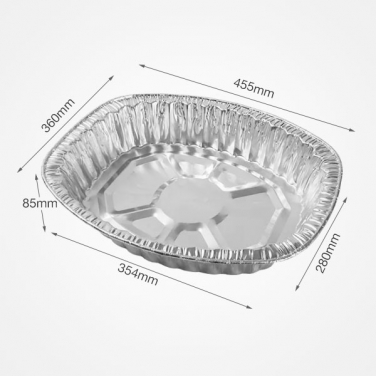
- JY-T455, the extra-large oval turkey tray, is listed at 6,800 ml and 73 g, and is described as heavy-duty construction for high-temperature oven use.
- JY-P252, the disposable foil hot pot, is listed at 1,800 ml and 30 g, and is described as heavy-duty 30 g.
Those gram figures are useful when you compare samples. They are not a substitute for a stated foil thickness, and they should not be read as a micron rating.
What AILVBO already publishes
The 2026 catalog lists 30 published models. Only one of them, the foil roll, has a thickness in micron. Several container models have a finished piece weight in grams. The other published models have no thickness and no piece weight on the product page or in the catalog; those values have to be confirmed on the quotation.
| Model | Type | Published size / capacity | Published thickness | Published piece weight |
|---|---|---|---|---|
| JY-FR30 | Foil roll | 30 cm width; 5 m or 10 m rolls | 10 micron | Not published |
| JY-8389 | Rectangular container | 210 × 140 × 45 mm, bottom 174 × 103 mm, 800 ml, 1,000 pcs/carton | Customizable; no micron figure published | Not published |
| JY-TR207 | Round egg tart cup | Ø 70 × 20 mm, 42 ml, 5,000 pcs/carton | Not published | 0.33 g |
| JY-GR161 | Rectangular container | 161 × 110 × 30 mm, 320 ml, 1,000 pcs/carton | Not published | 9.1 g |
| JY-A160 | Rectangular container (smoothwall) | 160 × 102 × 32 mm, 350 ml, 1,000 pcs/carton | Not published | 7 g |
| JY-G1100 | Rectangular roasting pan | 230 × 170 × 45 mm, 1,100 ml, 500 pcs/carton | Not published | 6.5 g |
| JY-T455 | Oval turkey tray | 455 × 360 × 85 mm, 6,800 ml, 50 pcs/carton | Not published | 73 g |
| A169 | Airline casserole | 169 × 110 × 33 mm, 500 ml, 1,000 pcs/carton | Not published | 6.6 g |
| A185 | Airline casserole | 185 × 118 × 25 mm, 350 ml, 1,000 pcs/carton | Not published | 5.1 g |
| JY-P252 | Specialty hot pot | 1,800 ml, 150 pcs/carton | Not published | 30 g |
| JY-CP1000 | Circular foil pot | 1,000 ml, 200 pcs/carton | Not published | 17 g + lid 7 g |
Among the airline models, JY-A135 (280 ml) has no published piece weight; the airline manufacturer guide already says to ask for it. The same is true of JY-8389 and of the other catalog models that are not in the table above: dimensions and capacity may be published, but thickness and weight are not.
The catalog also states that raw materials are checked for alloy and thickness, and that production checks include dimensions and wall thickness. This website does not publish a numerical thickness tolerance, so do not treat “checked” as a stated ± micron window. If you need a tolerance, ask for it on the quotation and check it on the sample.
Piece weight and foil thickness are related, but they are not the same number. Weight is the finished article, including the formed walls, the rim and any lid that is listed with it (JY-CP1000 is the only model here that publishes a separate lid weight). A deeper or larger tray can weigh more than a shallower one even if the starting foil is similar. That is why a complete specification names the model or the millimetre dimensions, the capacity, the foil thickness with a unit, and the finished piece weight.
For sizes and capacities rather than thickness, use the sizes guide. How the same figures appear on a factory quotation is covered in how to read a foil container spec sheet.
Alloy, and smoothwall versus pleated
AILVBO containers are published as food-grade 3003 and 8011 aluminum alloys, oven-safe to 260°C (500°F) and not for microwave use. This website does not say which published model is made from which alloy, and it does not publish a temper (O, H22, H24 or otherwise) per model. If alloy or temper matters to your order, name it on the RFQ.
In general industry practice, both alloys are used for disposable food containers. 8011 is a common foil alloy and forms well, which is why it is widely used for household foil and for many pleated containers. 3003 is an aluminium-manganese alloy and is often chosen where a bit more rigidity is wanted. Those are generic material facts, not a statement of what AILVBO uses on any one SKU. The manufacturers guide already advises buyers to have the factory state alloy, temper, foil thickness and finished weight for each item in writing.
Construction also changes how a given thickness behaves. On the smoothwall vs pleated comparison:
- Pleated (wrinkle-wall) containers have folded sides; wall strength varies with gauge.
- Smoothwall containers have seamless sides and are described as more rigid because of that construction. They are typically chosen for oven-to-table and retail display, and they usually cost more to produce.
A smoothwall tray and a pleated tray with the same top-out can therefore feel different even when the starting foil thickness is similar. Specify the construction you want, not only the micron figure. JY-A160 and JY-A135 are the published models that this website already describes as smoothwall.
How to choose thickness for the job, then confirm it on a sample
Use the end use to decide what to ask for, then lock the number with a sample. The points below are buying practice, not an AILVBO grade list:
- Light, relatively dry, short-hold portions can use a thinner foil than a gravy-heavy meal that will be stacked, held hot, or reheated in the oven. For the 8389 footprint, that distinction is already illustrated on the 8389 guide.
- Roasting and other high-load oven work depends on both size and stiffness. AILVBO’s published example of a large roasting tray with a piece weight is JY-T455 at 73 g. Published large pans from 1,000 ml to 7,200 ml, and the piece weights that are already listed, are also collected in the large-capacity foil container guide. AILVBO foil containers are oven-safe to 260°C. Do not put the tray in a microwave; lid rules are on the oven guide and the lids guide.
- Airline casseroles are specified as much by piece weight as by volume. The published figures are A185 at 5.1 g (350 ml) and A169 at 6.6 g (500 ml).
- A lid that does not fit will leak even if the tray itself is thick. Specify foil thickness and lid type on the same order.
Existing models can be sampled first. Samples of existing products are free, and the buyer pays shipping; sample lead time is 5–7 days. Weigh the sample, measure the top-out, height and capacity, and run it through your own fill, stacking and oven route before you approve a bulk order. How samples differ from a trial order is explained on the samples guide.
What to write on the RFQ
The RFQ checklist already has a line for “Thickness or piece weight (optional),” with the note that thickness is customizable. If you have a target, or a container you already use, say so; otherwise ask for the standard specification. One of the worked examples on that page is “Match the thickness of our current 8389 sample.”
Include, at least:
- 1. The published model, or the top-out, height and capacity in millimetres and millilitres if you need a new shape.
- 2. Quantity, destination and the trade term (FOB Qingdao or Shanghai).
- 3. Thickness with a unit (micron or mm), or a reference sample to match — and the finished piece weight in grams if you have a target.
- 4. Alloy and temper if you require them (3003 or 8011, if you have a preference).
- 5. Lid type and whether lids are quoted as a separate line.
- 6. Whether you need samples, and the courier details.
A copy-and-paste template is on the RFQ checklist, which can also be downloaded as a CSV file. UAE and Saudi buyers can also use the wholesale landing.
Published commercial terms that usually travel with that specification: standard MOQ 50,000 pieces per item, with a 10,000-piece trial for new customers; standard production 15–20 days after deposit; a new mold typically 15–20 days, then 25–30 days of production after mold approval; payment T/T 30/70 or L/C at sight. Custom designs may require a higher MOQ depending on mold complexity. Prices are confirmed on the quotation; this website does not list them.
Frequently asked questions
What thickness does AILVBO publish for its aluminum foil containers?
It does not currently publish a micron or millimetre thickness for individual container models. Thickness is customizable, including for JY-8389. The only published thickness figure is for the foil roll JY-FR30, at 10 micron. Some container models have a published piece weight in grams, which is listed in the table above and in the 2026 catalog. Other models have neither figure; ask for both on the quotation.
Is “gauge” the same as microns or millimetres?
In everyday purchasing, “gauge” usually means thickness, but it is not a single worldwide scale. Micron and millimetre are the same measurement (1 micron = 0.001 mm). A local gauge number or a “standard / heavy duty” label is not automatically the same as a micron rating. State the unit on the RFQ, or send a reference sample.
What does “heavy-duty” mean for a foil container?
It is a commercial label, not a published AILVBO grade and not a formal standard thickness. For the Gulf 8389 size, public listings often fall around 40–63 microns, with about 50–63 microns described as a more typical heavy-duty range for that footprint. On this website, JY-T455 is described as heavy-duty construction and is listed at 73 g; JY-P252 is described as heavy-duty 30 g. Those gram figures are not micron ratings. Ask for microns and grams, not only the words “heavy-duty.”
What thickness should I order for an 8389 container?
AILVBO does not publish a default micron rating for JY-8389; thickness is customizable. The 8389 guide records that public Gulf listings often fall around 40–63 microns and recommends asking for both the micron rating and the piece weight, then sampling under your real conditions. You can also ask the factory to match the thickness of a current 8389 sample, as in the RFQ example.
Should I specify thickness, piece weight, or both?
Both, if you can. Thickness describes the starting foil; piece weight describes the finished tray (and, where it is listed, the lid). Two trays can share the same top-out and still differ in stiffness. If you only have one of the two figures, send a physical sample to match.
Can I get a sample to check thickness before a bulk order?
Yes. Samples of existing models are free, and the buyer pays shipping. Sample lead time is 5–7 days. Weigh the sample and test it with your food, lid and oven or freezer route before you approve production. For a size or shape that is not already in the range, a new mold typically takes 15–20 days to develop.
Conclusion
Write thickness as a measured figure with a unit, not only as “heavy-duty” or a gauge nickname. AILVBO’s published record is a 10 micron foil roll (JY-FR30), customizable container thickness (including JY-8389), and piece weights on the models in the table above. The rest — a default container micron rating, a house heavy-duty grade, alloy by model, and a numerical tolerance — is not published, and belongs on the quotation and the sample approval.
Browse the catalog (PDF), use the RFQ checklist, or send the same details via the contact page, email fliany365@gmail.com, or WhatsApp/WeChat +86 15810953132.
Sources
Thickness, piece weights and commercial terms on this page are restated from live AILVBO product pages, the 2026 catalog, the RFQ checklist, the 8389 Gulf market guide, the foil roll buying guide, the manufacturers guide and the import guide. No unpublished container micron ratings, house heavy-duty grades, or wall-thickness tolerances are added.