Aluminum Foil Container Sizes Guide: How to Choose the Right Capacity
What Are the Standard Aluminum Foil Container Sizes?
Aluminum foil container sizes range from 42ml mini tart cups to 6,800ml industrial roasting pans, covering every food service application from individual desserts to catering-scale meals. The industry categorizes containers into five capacity tiers: small (42–250ml), medium (280–750ml), large (800–1,500ml), extra-large (1,800–2,500ml), and industrial (3,000–6,800ml).
Choosing the correct size reduces packaging waste by 15–22% and prevents food spillage during transport. Below is the standard size chart covering the full capacity range.
| Size Category | Capacity Range | Common Shapes | Typical Applications | |---|---|---|---| | Mini | 42–125ml | Round | Egg tarts, muffins, sauce cups, condiments | | Small | 150–300ml | Round, rectangular | Side dishes, desserts, children's meals | | Medium | 350–750ml | Round, rectangular, oval | Standard entrées, takeout, meal prep | | Large | 800–1,500ml | Rectangular, oval | Family portions, catering, combo meals | | Extra-large | 1,800–2,500ml | Rectangular, oval | Party trays, bulk roasting, catering | | Industrial | 3,000–6,800ml | Rectangular, oval | Commercial roasting, food processing |
How Do You Choose the Right Size by Use Case?
Match container capacity to your specific application using the guide below. Each use case has an optimal capacity range based on portion size, cooking method, and transport requirements.
| Use Case | Recommended Capacity | Recommended Shape | Why This Size | |---|---|---|---| | Takeout and delivery | 400–750ml | Rectangular | Fits standard entrées; stacks efficiently in delivery bags | | Baking (pies, cakes, casseroles) | 350–1,000ml | Round | Even heat distribution for consistent crust browning | | Roasting (meat, poultry, fish) | 2,000–6,800ml | Oval, rectangular | Accommodates whole proteins with airflow for browning | | Airline and rail catering | 280–500ml | Rectangular, round | Standardized portion control for meal service | | Camping and outdoor | 1,000–1,800ml | Rectangular, oval | Hearty portions; disposable after use | | Meal prep and portion control | 500–750ml | Rectangular | Single-serving standard for nutrition tracking | | Condiments and sauces | 42–125ml | Round | Small portions; prevents waste | | Desserts and bakery | 150–350ml | Round | Individual servings for presentation |
How Do You Measure Aluminum Foil Containers?
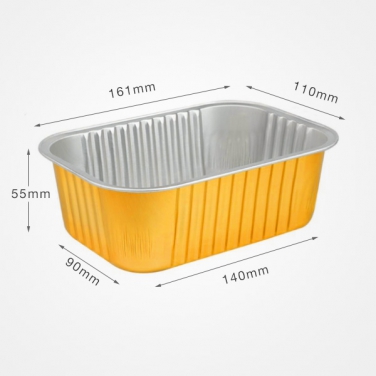
Aluminum foil containers are measured using five key dimensions: top outer diameter (topOut), top inner diameter (topIn), base dimension, height, and capacity. Understanding these measurements ensures compatibility with lids, oven racks, and transport containers.
Measurement definitions:
- TopOut (top outer dimension) – The widest point at the container rim; determines lid compatibility and stacking width
- TopIn (top inner dimension) – The opening inside the rim; affects how much food can be loaded
- Base – The bottom dimension; determines footprint on oven racks and in delivery bags
- Height – Measured from base to rim; critical for lid selection and stacking height
- Capacity – Liquid volume the container holds when filled to 5mm below the rim
- TopOut: 185 × 135mm
- Base: 155 × 105mm
- Height: 45mm
- Capacity: 930ml
What Are the Most Popular Aluminum Foil Container Sizes?
The 500ml rectangular container is the single most popular aluminum foil container size globally, accounting for approximately 30% of all B2B orders. This size fits a standard protein-starch-vegetable entrée configuration and works for takeout, delivery, meal prep, and bakery applications.
Top 5 most ordered sizes:
1. 500ml rectangular – Universal entrée container; works for 80% of standard menu items 2. 750ml rectangular – Larger entrées and pasta dishes with sauce 3. 1,000ml rectangular – Family portions and catering 4. 250ml round – Side dishes, desserts, and bakery items 5. 125ml round – Egg tarts, muffins, and condiment cups
What Are AILVBO's Most Popular Container Models?
AILVBO manufactures 300+ container models across all capacity tiers. Below are four representative models covering the most common applications, with exact specifications for buyer reference.
| Model | Capacity | Shape | Dimensions (TopOut) | Best Use Case | |---|---|---|---|---| | A169 | 500ml | Rectangular | 185 × 127mm | Standard takeout entrées, meal prep | | JY-GR161-680 | 680ml | Rectangular | 200 × 145mm | Larger entrées, pasta, rice dishes | | JY-R9 | 930ml | Rectangular | 185 × 135mm | Family portions, catering trays | | JY-T455 | 6,800ml | Rectangular | 535 × 325mm | Commercial roasting, whole turkeys |
Model selection guidance:
- A169 (500ml): The industry workhorse. Choose this for restaurants standardizing on a single container size for 80%+ of their menu.
- JY-GR161-680 (680ml): Ideal for pasta-heavy menus where sauce displacement requires 20–30% extra volume over standard portions.
- JY-R9 (930ml): Bridges the gap between individual and family portions. Works for combo meals and two-person catering.
- JY-T455 (6,800ml): Industrial-scale roasting pan. Fits a 5–6kg turkey or two whole chickens with vegetables.
How Does Container Size Affect Cooking Performance?
Container size directly impacts heating time, temperature uniformity, and food quality. Smaller containers heat faster and more evenly, while larger containers require longer cook times and careful temperature management.
Size-based cooking adjustments:
| Container Size | Reheat Time Adjustment | Temperature Note | |---|---|---| | Under 350ml | Reduce by 15–20% | Heats rapidly; risk of overcooking edges | | 400–750ml | Standard | Most predictable; even heat distribution | | 800–1,500ml | Increase by 15–20% | Center heats slower; rotate midway | | 1,800–2,500ml | Increase by 25–30% | Vent lid to prevent pressure buildup | | 3,000–6,800ml | Increase by 35–45% | Use lower temp (160–180°C) for longer period |
Conclusion
Selecting the right aluminum foil container size requires matching capacity to your specific use case, understanding five key measurements, and testing with your actual menu items. Standardize on 3–4 sizes to cover 90% of your applications: a 500ml rectangular for entrées, a 250ml round for sides and desserts, a 1,000ml rectangular for family portions, and a 42ml round for condiments.
Request technical drawings and free samples from AILVBO to verify dimensions and compatibility before placing bulk orders. All 300+ models are available with matching lids and full OEM customization.